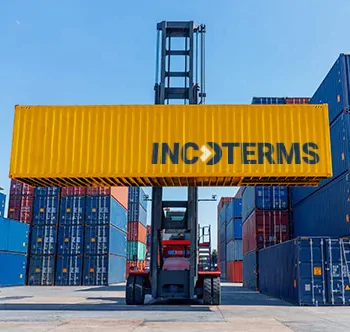
Effective logistics begins with the right choice of equipment. When planning international delivery, understanding the technical characteristics of the container allows you to avoid unnecessary costs and ensure the safety of your property. Euro Forwarding helps customers understand all the details to make your sea transportation as cost-effective and reliable as possible. Let’s take a closer look at the main types of equipment used in global practice:
- Dry Van (DV) or General Purpose (GP): these are the most common containers we see in ports. They are completely sealed, made of corrugated steel, and designed for a wide range of “dry” goods, from household appliances to textiles.
- High Cube (HC): identical in structure to standard containers, but one foot (approximately 30.5 cm) taller. This makes them ideal for light but bulky goods.
- Open Top (OT): instead of a metal roof, a removable tarpaulin or awning is used. This solution is for goods that cannot be loaded through the door, but only vertically using a port crane.
- Flat Rack (FR): consist of a rigid base and end walls. This is an indispensable option for oversized structures, machine tools, or special equipment.
- Refrigerated (Reefer): These are true “refrigerators on water.” They are equipped with units to maintain a stable temperature from -35 °C to +30 °C.
- Tank Containers (ISO Tank): used for bulk chemical and food products. This is a tank mounted in a standard metal frame.
- Platform (P): this is essentially a loading platform without side and end walls, designed for extra-heavy and oversized products.
Choosing a specific type is the first step in determining how safely your cargo will be transported. For example, using refrigerators for fruit or meat requires not only knowledge of dimensions, but also control over the operation of technical units throughout the entire journey. 
Dimensions of standard containers (20′, 40′, and others)
The technical characteristics of the equipment are the foundation on which calculations are based. When we plan sea container transportation (FCL/LCL), every millimeter of interior space matters. Although the external dimensions are usually fixed, the internal usable area can vary depending on the wall thickness and manufacturer. The most commonly used models worldwide are 20-foot and 40-foot containers. However, there are also less popular options that are important for specific niches, such as 45-foot High Cube containers.
20-foot containers (Standard/Dry Van)
These modules are considered the basic unit of measurement in logistics (TEU — Twenty-foot Equivalent Unit). They are designed to transport heavy but not overly bulky goods.
|
Parameter |
Value (meters) |
| Length (external/internal) | 6.058 / 5.898 |
| Width (external/internal) | 2.438 / 2.352 |
| Height (external/internal) | 2.591 / 2.393 |
| Door opening width | 2.340 |
| Door opening height | 2,280 |
| Volume | 33.2 m³ |
| Tare weight | ~2,230 kg |
| Max. load capacity | ~28,200 kg |
40-foot containers (Standard and High Cube)
This is the main working tool for transcontinental routes. At Euro Forwarding, we actively organize full container load (FCL) shipments from China, India, the US, Europe, and other countries around the world, where 40-foot HC containers account for the lion’s share of orders due to their capacity.
|
Parameter |
40′ Standard |
40′ High Cube |
| Internal length | 12.032 m | 12.032 m |
| Internal width | 2.352 m | 2.352 m |
| Internal height | 2.393 m | 2.698 m |
| Volume | 67.7 m³ | 76.4 m³ |
| Maximum cargo weight (payload) | ~26,700 kg | ~26,500 kg |
It is important to note that although a 40-foot box is almost twice as long as a 20-foot box, its maximum load capacity is often lower. This is due to design limitations and safety considerations when maneuvering in ports. Therefore, for metal ingots, it is better to take two 20′ containers, and for toys or shoes, one 40′ HC.
45-foot High Cube containers
They are less common, but indispensable when you need to transport very large batches of light goods. They are 13.716 m long, which gives them a significant advantage in terms of volume (about 86 m³). However, it is worth remembering that not all car trailers are designed for such a length, which can complicate further ground transportation.
How to choose a container for a specific cargo
The efficiency of delivery depends, in particular, on your ability to correctly assess the parameters of the goods at the packaging stage. Choosing a container is a balance between physical size, weight, and budget. We recommend paying attention to the following aspects:
- Pallet dimensions: the most common in the world are Euro pallets (1.2 × 0.8 m) and American pallets (1.2 × 1.0 m). A 20-foot container can hold 11 Euro pallets in one layer, and a 40-foot container can hold up to 24–25 (depending on the arrangement). If your cargo is not palletized, the calculation becomes more complicated and requires taking into account empty spaces.
- Specific weight: there is such a thing as “volume weight.” If the goods are heavy, they quickly exhaust the payload limit, leaving half the space empty. In this case, there is no point in overpaying for a High Cube. Ventilation requirements: Some industrial goods or chemicals require a constant air supply to avoid condensation. In this case, standard containers may not be suitable, and special ventilated equipment will be required.
- LCL vs FCL: if your shipment volume is less than 15³, a full container will be economically unprofitable. For such cases, we organize container transportation of consolidated cargo (LCL) from China, India, Europe, and other countries around the world. You only pay for the space that your goods actually occupy.
It is also worth considering the geography of the destination port. Some small ports do not have cranes powerful enough to handle 45-foot modules or do not accept specific types of containers. Our logistics team takes these “pitfalls” into account even before the ship leaves the port of departure. 
Features of maritime container transportation
Sea transport is the cheapest way to deliver goods over long distances, but it has its own characteristics. The main one is intermodality: containers serve as a universal shell that can be transferred from one mode of transport to another without unpacking the contents. This is the basis of safety.
Here are a few factors that characterize this process:
- VGM (Verified Gross Mass): According to international conventions, each shipper is required to provide the verified weight of the container before it is loaded onto the ship. An error in the figures can result in fines or even refusal to load.
- Documentary support: in addition to the invoice and packing list, the bill of lading is key. This is a legal document confirming ownership and the terms and conditions of maritime transport.
- Customs control: containerization simplifies inspection. Customs authorities can use scanners to check the contents without breaking the sender’s seal.
- Seasonality and freight rates: the cost of space on a ship is constantly changing. This is influenced by fuel prices, the availability of empty equipment in the region, and global trade cycles.
It is important to understand that sea transport takes longer than air or road transport, so planning must be strategic. The use of containers allows you to create so-called “floating warehouses” where the goods are already on the way and you are already planning their sale.
Tips for the effective use of containers in transportation
In order for your business to get the most out of the voyage, it is necessary to optimize each stage — from ordering the container to unloading it at the warehouse. Choosing the right container size is only part of the success.
Based on Euro Forwarding’s experience, we have compiled recommendations that will help you save money and time:
- Use modern software for loading: programs such as SeaRates or CargoWiz will help you visualize how to place boxes of different sizes to minimize empty space.
- Take care of fastening: Even if the cargo fills the entire volume, it can shift during a storm. Use inflatable bags, stop bars, and tie-down straps. This is especially important when transporting fragile goods in containers.
- Check the condition of the equipment before loading: make sure there are no foreign odors, holes in the roof, or traces of chemicals from previous orders. Any malfunction is a risk to your goods.
- Optimize the weight balance: heavy goods in the center of the container make it more stable. Avoid concentrating all the weight in one corner, as this can cause problems when lifting with a crane or during truck transport.
- Keep track of demurrage and detention times: these are penalties for delaying a container at the port or for exceeding the standard use of equipment outside the port. Fast unloading is the key to savings.
The world of global trade is constantly changing, but standard containers remain an unchanging symbol of stability and order. We hope this overview has helped you better understand the technical aspects behind each voyage, because the right approach to equipment selection is an investment in the safety of your business.
FAQ
- What are the main types of shipping containers used globally, and what are they designed for?
Various types and sizes of containers are used for transport. Standard 20- and 40-foot containers are suitable for general cargo, whilst Open Top, High Cube and Flat Rack models are used for oversized cargo.
- How do High Cube (HC) containers differ from standard models?
This container is 30.5 cm taller than a standard one. Thanks to this modification, High Cube containers have a greater volume.
- Why is the maximum load capacity of a 40-foot container often lower than that of a 20-foot container?
Due to road restrictions on the total (gross) weight of the vehicle. The permissible weight of the container plus cargo is the same for both (usually ~30 tonnes), but the tare weight of a 40-foot container is greater, so there is less weight available for the cargo.
- How many standard Euro pallets can fit into a 20-foot and a 40-foot container?
The standard is 11 pallets in a 20-foot container and up to 25 in a 40-foot container. Correct utilisation optimises the cargo space inside both 20-foot and 40-foot containers.
- What is the VGM regulation in maritime transport and why is it important?
The VGM rule requires the accurate gross mass of the cargo to be provided in advance. An official weight specification guarantees the safety of the vessel and ensures accident-free maritime operations.
- What do the terms ‘demurrage’ and ‘detention’ mean, and how can businesses avoid these financial losses?
Demurrage is a charge for storing a container at the port beyond the free period; detention is a charge for delaying the return of an empty container outside the port. To avoid these costs, prepare documents in advance, plan the collection and return of the container, check its technical condition and try to stay within the free rental period.