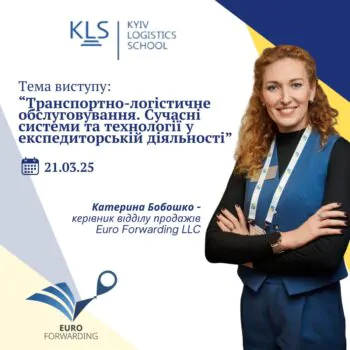
Kateryna Boboshko, Head of Sales and Customer Service at Euro Forwarding.
Amid a full-scale war, the Ukrainian logistics market is operating in an environment of constant change. Routes are shifting, transport corridors are changing, and risks and costs are rising. At the same time, customer expectations are also changing significantly: businesses are seeking maximum reliability, predictability, and efficiency in logistics solutions.
The Balance Between Service and Cost-Effectiveness
In 2026, customers are placing particular emphasis on a comprehensive approach to logistics. For businesses, it is important to secure not only transportation services but also a partnership that includes supply stability, prompt communication, alternative routes, and the financial reliability of the logistics provider.
At the same time, cost optimization remains a priority for many companies. That is why, when choosing a partner, customers strive to find the optimal balance between the cost of services, service quality, and the freight forwarder’s level of accountability.
For logistics companies, this means a constant need to improve operational efficiency. Key areas of development include:
- optimizing operational processes without compromising service quality;
- automating and digitizing workflows;
- increasing team productivity;
- implementing clear internal operating standards;
- systematic financial and risk management.
Practice shows that consistent service is impossible without a systematic approach to business management. It is precisely transparent, manageable, and scalable processes that enable both high service quality and competitive pricing.
“With over 15 years of experience in logistics sales, I can confidently say: during times of crisis, clients particularly value partners who can ensure supply chain stability, respond quickly to changes, and offer effective solutions,” notes the expert.
It’s not the price that matters, but the proposal.
Today, many companies place significant emphasis on effective cost management. This is a natural business response to economic instability. That is why an increasing number of organizations are using tender mechanisms to select logistics partners.
Tender platforms allow companies to compare market proposals and find optimal solutions. At the same time, in practice, the winning bid is often not just the lowest price, but the proposal that offers the best balance of price, service, and reliability.
In today’s environment, logistics is much more than just the transportation of goods. It is a complex system of risk management, route coordination, and rapid response to changes.
That is why, when choosing a partner, clients are increasingly focusing not only on rates but also on the team’s experience, the availability of alternative logistics solutions, the freight forwarder’s financial stability, and the level of customer support.
The sales department’s task in such conditions is not only to develop a competitive commercial proposal but also to help the client assess the full economic impact of the logistics solution, including potential risks and opportunities for optimization.
Service as the Foundation of Long-Term Partnerships
During times of instability, the quality of customer service becomes particularly important. Prompt communication, transparent processes, and proactive updates on changes at borders or in port operations help customers plan their activities more effectively.
Today, customers expect not only a response to their inquiries from a logistics partner, but also ready-made solutions. As a result, sales are increasingly shifting toward consultative support: analyzing supply chains, identifying alternative routes, and exploring opportunities for cost optimization.
Digitalization as the Standard in Modern Logistics
Automated billing, integration with clients’ ERP systems, and online shipment tracking have already become an integral part of modern logistics.
The speed of preparing commercial proposals, the accuracy of calculations, and the transparency of shipment statuses often become key factors when selecting a partner.
A separate challenge for businesses has been the shift in work formats. Many companies operate remotely or in a hybrid mode, which requires new approaches to process organization and communication.
In such conditions, digital tools help maintain operational stability: centralized databases, automated control systems, and backup communication channels ensure business continuity even in challenging circumstances.
By 2026, customers will increasingly value partners who can guarantee operational stability regardless of external factors—from energy challenges to changes in team workflows.
Building Partnerships with Clients
In today’s business environment, companies place significant emphasis on developing long-term partnerships with clients. Regular business meetings, KPI analysis, personalized solutions, and prompt support help enhance the effectiveness of collaboration.
At the same time, developing new partnerships also remains a key component of business growth. It is the combination of expanding the customer base and strengthening existing relationships that drives the company’s stable growth.
Partnership as the Key to Stability
Despite the widespread use of tendering mechanisms, long-term partnerships remain a vital component of the logistics market. Clients who have had positive experiences working together during challenging times better understand the value of a reliable logistics partner.
Euro Forwarding’s strategy is based on fair competition, transparent pricing, and the continuous improvement of internal processes. We optimize operations, invest in digital solutions and team development to provide clients with stable service and competitive logistics solutions even in challenging market conditions.